
Freezing
A sudden stop, where a moving dog holds completely still with tension through the body, is often a late warning, high on the ladder of aggression. Treat it as a request for space and stop what you are doing. Loose, brief stillness while a dog watches or listens is different.
What it looks like
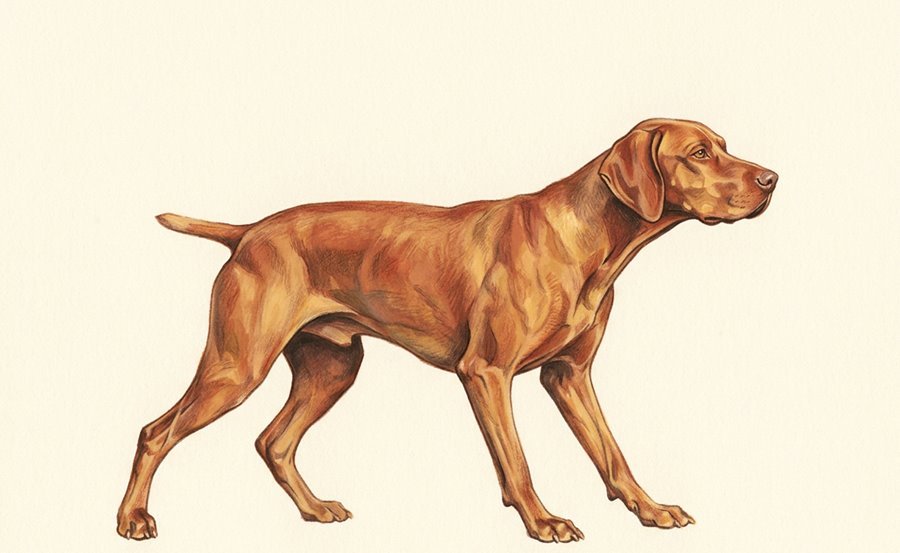
Movement stops mid-action and the dog holds the position, often with one foot still lifted. The topline is level and rigid rather than curved. The mouth closes, the eyes lock on one point without scanning, and the tail stops moving and holds where it was, high or low. Breathing may become shallow or pause visibly. The stillness lasts longer than a normal pause, and the dog does not blink, sniff, or shift weight.
What it often means
In the ladder of aggression a hard freeze sits well above the quiet signals such as lip licking and head turning, and close to stiffening and staring, which come shortly before growling and snapping. Read it as one of the last requests before an escalation. The ladder is a teaching model, so the order is approximate rather than fixed.
Stillness organised around food, a chew, a bed or a taken object is typically resource-related. Guarding what matters is normal dog behaviour rather than defiance, and clinical accounts describe it hardening in dogs whose valued items have repeatedly been removed by hand.
Freezing appears in frightened dogs when escape is blocked: on lead, in a corner, behind a barrier or under restraint. The distance the dog would have taken is not available, so stillness is what remains.
A short pause in an otherwise loose body is ordinary orienting. Something has been detected, the dog is gathering information, and the pause resolves by itself without anyone intervening.
Practitioner accounts also describe brief stillness as a calming signal that lowers social pressure. That description is practitioner-derived rather than peer-reviewed, and in the moment it is genuinely hard to separate from a warning freeze, so err toward giving space.
Dogs whose growls or stiffening have been punished may show a very short freeze, or none you can catch. Survey and review work links confrontational and aversive methods to aggressive responses and poorer welfare. The shortened warning itself is clinical inference rather than something anyone has measured.
What it does not mean
- A frozen dog is not a calm dog and is not being good. Stillness with tension through the body is close to the opposite of settling: the softer options have already been offered and have not worked.
- It is not stubbornness, defiance, or a challenge to your authority. Treating it as a contest to be won raises the risk of a bite and does nothing about the feeling underneath.
- A dog who goes still when you come home to damage is not confessing. In controlled work the guilty look tracked being scolded rather than whether the dog had done anything.
What changes the reading
| When | Effect on the reading |
|---|---|
| Food, a chew, a bed or a taken object is involved | Read it as resource-related and stop approaching. Do not take the item back by hand. Manage access so the situation is not rehearsed, and get professional help for anything beyond mild. |
| A child is nearby | Separate them now rather than trying to manage the moment, then supervise properly afterwards. Children tend to close distance when a dog freezes, which is the worst available response. |
| The dog is on lead, cornered, or held | The freeze may be fear with no exit. Release the pressure, drop the lead tension, and open a route out rather than continuing to approach. |
| It happens during hugging, leaning over, restraint, grooming or a veterinary visit | Stop the handling and rebuild it in small steps with cooperative, low-stress technique. A dog who freezes under handling is tolerating, not consenting. |
| The freeze is new, happens when one particular area is touched, or the dog is older | Arrange a veterinary examination first. Pain is frequently involved in dogs presented for behaviour problems and is easily mistaken for a change of character. |
Read the whole dog
Seen together, these strengthen it
- A hard, unblinking stare fixed on one point
- Whites of the eyes showing while the head stays still
- Closed mouth with tension at the corners, or lips tightening
- Tail high and rigid, or clamped and motionless
- Weight carried forward over the front feet
- A low growl, or breathing that seems to be held
Seen together, these point elsewhere
- The dog resumes movement within a second and shakes off
- Ears swivelling while the face stays soft
- A play bow immediately before or after
- A loose, sweeping wag with a wriggling body
- The dog chooses to move toward you and re-engage
How confident we are
The freeze comes from clinical consensus and teaching material rather than experiment. No study we are aware of has measured how often a freeze precedes a bite, or how long the window is, and the ladder's order is a model rather than a fixed sequence. Distinguishing a warning freeze from ordinary watching depends on tension that thick coats hide, and some dogs give almost no freeze at all.
Safety
Common questions
My dog freezes when I go near his food bowl. What should I do right now?
Stop where you are, do not reach for the bowl, and move away without turning it into a contest. Feed in a quiet space with the door open so nobody needs to pass, and stop reaching into the bowl as a test. Guarding is normal behaviour, and rehearsing the conflict strengthens it. If it happens often, get force-free professional help.
Is freezing the same as a dog just being still or thinking?
Ordinary watching is loose. The ears move, the dog blinks, the weight shifts, and the pause ends by itself within a second or two. A warning freeze is rigid, the eyes stay locked, and the stillness holds while you keep approaching. If you cannot tell which one you are seeing, treat it as the warning.
Should I correct my dog for freezing so it does not become a growl?
No. Punishing a warning can remove the signal without changing the feeling underneath, which leaves a dog who escalates with less notice. Surveys and reviews of confrontational and aversive methods link them to higher rates of aggressive responses and poorer welfare. Change the situation instead, and get help from a qualified force-free professional.
Sources for this entry
Every claim above is graded. Open the source register for the full citation, what it actually establishes, and its limits.
Practical guides
Longer, practical write-ups on the everyday side of this.
See it in context
A single signal is never enough on its own. Put this one together with the rest of what you are seeing, and the interpreter will show you the reasoning and how confident it is.
Method last updated . Built from and checked against the sources listed above. Think we got this wrong?