
High stiff tail
A tail held high and rigid, often trembling in short fast strokes, usually indicates strong arousal aimed forward at something. It often accompanies a warning or guarding, though the same tail appears in intense play and chasing. Stop approaching, add distance, and read the mouth, eyes and body before doing anything else.
What it looks like
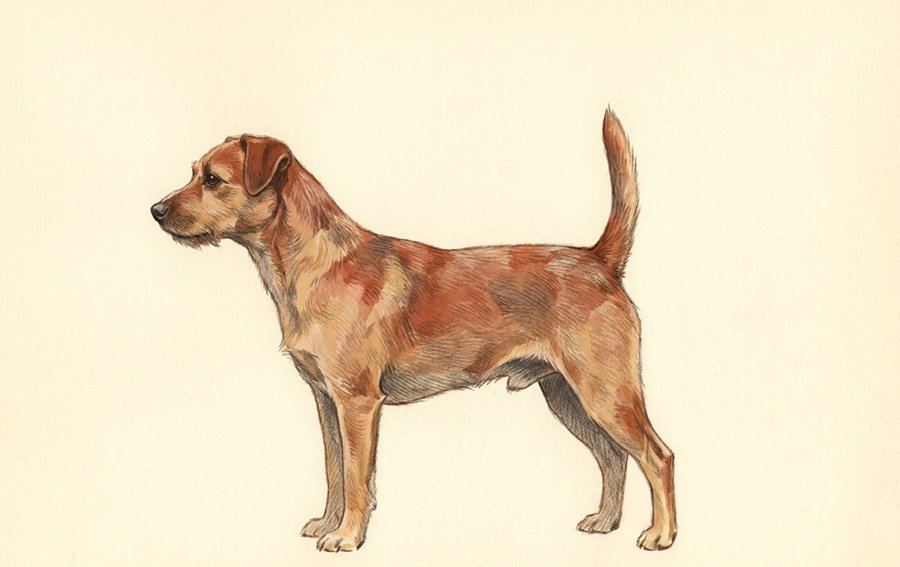
The tail sits clearly above the dog's own neutral line and stays there, without the soft sway of a resting tail. The base looks thick and set, and the tail often trembles or flags in a short, fast arc rather than sweeping. Look for a tall stance, weight over the front feet, a closed or short-pushed mouth, and hair standing up over the shoulders or tail base.
What it often means
Warning. High, rigid carriage typically appears beside the upper rungs of the ladder of aggression, such as a stiffened body, a hard stare and a growl. Where those show up together, a snap can follow if the pressure continues.
Resource guarding. Over food, a chew, a bed or a person, the high stiff tail typically appears with a frozen body and a hard, sideways look.
High arousal without hostility. Chasing, hunting, or greeting an exciting arrival can produce a very similar tail, because arousal and pleasantness are separate dimensions. The mouth, the eyes and the quality of movement decide the reading.
Between two dogs, a high stiff tail at the moment of meeting raises the chance of a scuffle, especially in a narrow space, on lead, or where neither dog can leave.
A threshold lowered by pain. A dog that has started going tall and stiff in situations it used to tolerate deserves a physical examination before any behavioural label.
Some individuals and some breeds carry a naturally high or curled tail, and breed predicts little about behaviour. The rigidity, and the change from that dog's baseline, carry the information rather than the height itself.
What it does not mean
- A high stiff tail is not a claim to dominance or pack rank. Responding with alpha rolls, scruffing or staring the dog down raises the risk of being bitten and has no support in the research.
- It is not proof of aggression either. The same tail appears in intense play and excited greeting, where play bows and role swaps mark the interaction as mutual. The difference lies in the mouth, the eyes, and whether movement is loose or braced.
- A raised tail that is also moving is not a friendly wag. Fast, small, stiff movement of a high tail reports arousal rather than welcome, and it is frequently mistaken for friendliness.
- This is not a display to train out with a correction. Aversive methods raise stress, worsen welfare, and are associated with more aggressive responses, and a dog that stops warning still feels the same way.
What changes the reading
| When | Effect on the reading |
|---|---|
| Food, a chew, a toy or a resting place is present | Treat it as guarding until proven otherwise. Stop approaching, call the dog away for something better, and manage access to the item rather than taking it. |
| Two dogs meeting on lead in a narrow space | Create distance and change the angle. Tight leads and face-to-face approaches raise the odds of a scuffle. |
| The dog is behind a fence, window or other barrier | Arousal builds quickly with no outlet. Interrupt by adding distance and scattering food away from the barrier, not by correcting. |
| During a chase, a flirt pole game, or a squirrel sighting | The same tail can be plain predatory arousal. The main risk is redirection onto whatever is nearest, including hands and lead. |
| The dog also freezes and goes silent | Stop. A freeze on a high tail is a late-stage signal and the margin before a bite is very short. |
| A child is in the room | Move the child away first, calmly and without grabbing the dog, and keep them apart until you have professional help. |
Read the whole dog
Seen together, these strengthen it
- A hard, fixed, unblinking stare
- Weight forward, body tall and braced
- Lips pushed short and forward, or teeth visible with a tense face
- Hackles raised over the shoulders and rump
- A sudden freeze, or a low growl
Seen together, these point elsewhere
- A play bow, or repeated bouncing role swaps
- Loose, wriggling hips with the whole rear moving
- An open, relaxed play-face with a lolling tongue
- A naturally curled tail on a spitz-type dog at rest
- The dog breaking off easily and shaking off
How confident we are
The clinical description here is consistent, but the underlying evidence is observational rather than experimental, and nobody has quantified how often a high stiff tail is followed by a bite. Play and threat share a great deal of the same tail. Breed differences in tail set are large, and individual dogs vary more than breed does.
Safety
Common questions
Is a high wagging tail friendly?
Not necessarily. Height and stiffness matter more than movement. A tail held above the dog's normal line and vibrating in short, fast strokes usually accompanies arousal that could tip either way, and it often precedes a growl or a snap. A friendly greeting tends to look looser and lower, and involves the whole rear end.
My dog does this over his bones. What should I do?
Manage first, train later. Stop approaching him while he has the item, keep children and other pets away, and feed high-value chews behind a closed door or barrier. Trade from a distance for something better rather than taking things. Guarding responds well to structured force-free work with a qualified behaviourist; confrontation makes it worse and less predictable.
My spitz always has a high tail. Is he always aroused?
No. Curled and high-set tails are a conformation feature, so the resting position tells you little. Watch instead for change: a tail that rises further, stiffens, stops its normal easy movement, or trembles. Compare the dog with himself ten minutes earlier rather than with a chart drawn for a Labrador.
Should I tell my dog off when his tail goes up and stiff?
No. That display is information, and punishing it teaches the dog to hide the early stages while the underlying feeling stays. Dogs trained with confrontational methods show more aggressive responses and poorer welfare. Add distance, remove the trigger, and get help from a force-free behaviourist and your vet.
Sources for this entry
Every claim above is graded. Open the source register for the full citation, what it actually establishes, and its limits.
Practical guides
Longer, practical write-ups on the everyday side of this.
See it in context
A single signal is never enough on its own. Put this one together with the rest of what you are seeing, and the interpreter will show you the reasoning and how confident it is.
Method last updated . Built from and checked against the sources listed above. Think we got this wrong?