
Whale eye: the crescent of white
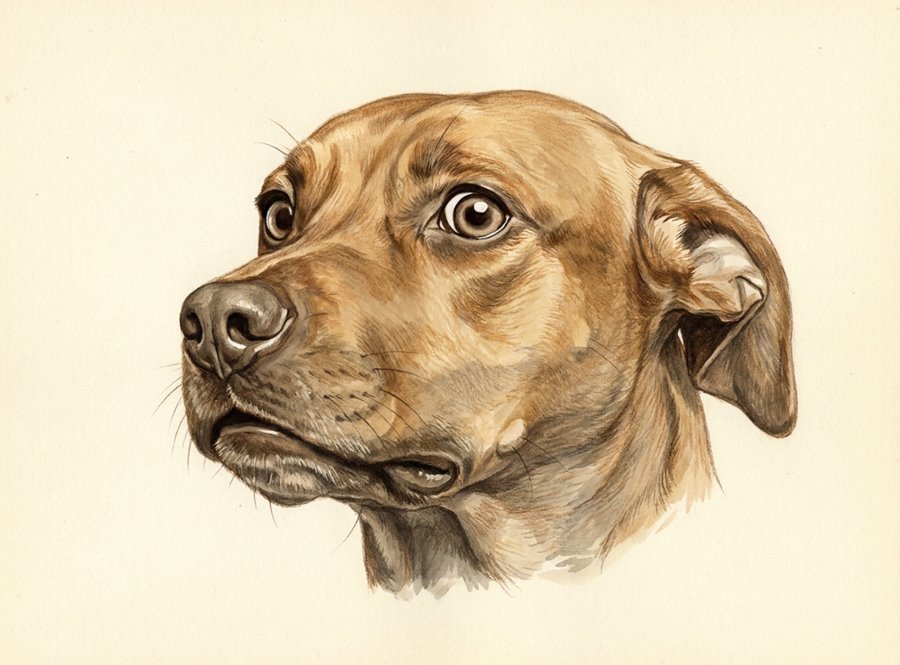
Whale eye is the crescent of white that shows when a dog holds their head away while keeping their eyes fixed on something. It usually signals discomfort and a request for more space. It is not proof a bite is coming, but treat it as a stop sign and ease the pressure.
What it looks like
The head is angled away from whatever the dog is watching while the eyes stay locked on it, so a half-moon of white shows at the inner or outer corner. The eyelids are usually tightened rather than round and soft. You may see a wrinkle or ridge above the eye, a closed mouth, and a body that has gone still. Sclera visible on both sides, with the head facing forward, is a different picture.
What it often means
Discomfort with what is happening, combined with an unwillingness to let it out of sight. On the clinical escalation ladder this maps to the stretch between turning away and stiffening with a stare, below growling, snarling and snapping.
A request for distance during handling: hugging, grooming, being leaned over, having a collar taken, or having a resting place approached. It commonly eases as soon as the pressure stops, though a dog who has been pushed through it repeatedly may stay tense for longer.
Conflict between two pulls, wanting to leave and wanting to keep the trigger in sight, which is why the head and the eyes end up pointing in different directions.
Resource-related tension around food, chews, toys, a bed or a person, where the dog monitors an approach without moving their body.
Pain rather than mood. A dog who has newly started showing whale eye when lifted, groomed or touched in one area may be sore, and pain is a documented, easily missed cause of reduced tolerance of handling.
Nothing emotional at all. Some dogs show white simply tracking movement with the head held still, particularly those with prominent or shallow-set eyes.
Practitioner literature groups head-turn-with-fixed-gaze among stress and calming signals. That source is practitioner-derived rather than peer-reviewed, so weigh it alongside the clinical ladder rather than on its own.
What it does not mean
- Whale eye is not guilt or shame. The whites-showing, head-lowered face photographed next to chewed shoes is produced in response to a person's scolding, not to the dog's earlier behaviour.
- It is not a dog being dramatic, manipulative or defiant, and it is not something to correct. Punishing it removes the visible warning while leaving the discomfort untouched, which is how dogs come to be described as biting without warning. Aversive methods are also linked to poorer welfare and more fear-related behaviour.
- It is not proof that aggression is imminent either. Plenty of dogs show whale eye across a whole lifetime and never bite, so read it as information about this moment, not as a countdown.
What changes the reading
| When | Effect on the reading |
|---|---|
| The dog is holding food, a chew, a bone or a toy | Stop approaching entirely. Trade later from a distance with something better, rather than removing the item by hand. |
| A child is hugging, leaning on, or kissing the dog | This is the highest-risk configuration on this page. Calmly move the child, not the dog, without scolding either of them, and rearrange the setup so it cannot happen again. |
| Brachycephalic or prominent-eyed dogs | Some sclera is visible at rest, so compare with the same dog fully relaxed before calling it whale eye. |
| The dog is on a lead, on a grooming table, or in a consulting room | Escape is blocked, so the signal carries more weight and the situation can escalate faster. |
| New or worsening in a dog who previously tolerated handling | Consider pain. Musculoskeletal and dental pain often show up first as reduced tolerance of touch, so book a veterinary examination. |
| The dog is asleep or being woken | Startle and disorientation can produce the same look. Wake dogs with your voice from a distance rather than by touch. |
Read the whole dog
Seen together, these strengthen it
- Closed, tight mouth after a period of panting
- Body freeze, or movement slowing noticeably
- Ears back or clamped
- Lip-lick or tongue flick with no food present
- Weight shifted away while the head stays turned toward the trigger
- Low, stiff tail or a small, tight, fast wag
Seen together, these point elsewhere
- Loose whole-body wiggle with a soft, open mouth
- Play bow aimed at the same target
- The dog choosing to re-approach once given room
- Soft blinking, with the head and eyes pointing the same way
How confident we are
No controlled study isolates whale eye and measures what follows it. The strongest support is the clinical escalation ladder and the handling literature, which are expert consensus built on case observation rather than experiment. Calming-signal descriptions are practitioner-derived and not peer-reviewed. Baseline sclera visibility also varies enormously with skull and eye shape, so individual comparison matters more than any general rule.
Safety
Common questions
Is whale eye always a warning that my dog will bite?
No. It marks discomfort dependably enough to act on, but plenty of dogs show whale eye across a lifetime and never bite. Its value is as an early stop signal: something in the situation is unwelcome, and the dog is signalling for it to end quietly. Acting on it every time keeps the warning intact and keeps escalation unnecessary.
My dog shows whale eye when I hug him. Is that bad?
It means the hug is not welcome at that moment, even from a person he is closely bonded to. Hugging takes away the option to move off, and many dogs tolerate it rather than enjoy it. Sit beside him instead and scratch his chest for three seconds, then stop and see whether he asks for more.
How do I tell whale eye from a dog just glancing sideways?
Look at the eyelids and the body. Casual sideways glances come with soft, round-lidded eyes, a mouth that stays loose, and a body that keeps moving. Whale eye comes with tightened lids, stillness, and a head deliberately angled away from the thing being watched. If the dog is also frozen, treat it as whale eye.
Should I correct my dog for showing whale eye?
Never. Suppressing a warning does not change how the dog feels; it removes the part you could see. Reviews of aversive methods link them to poorer welfare and more fear-related behaviour. Change the situation instead, give space, and get help from a force-free professional if it keeps happening.
Sources for this entry
Every claim above is graded. Open the source register for the full citation, what it actually establishes, and its limits.
Practical guides
Longer, practical write-ups on the everyday side of this.
See it in context
A single signal is never enough on its own. Put this one together with the rest of what you are seeing, and the interpreter will show you the reasoning and how confident it is.
Method last updated . Built from and checked against the sources listed above. Think we got this wrong?