Tucked tail
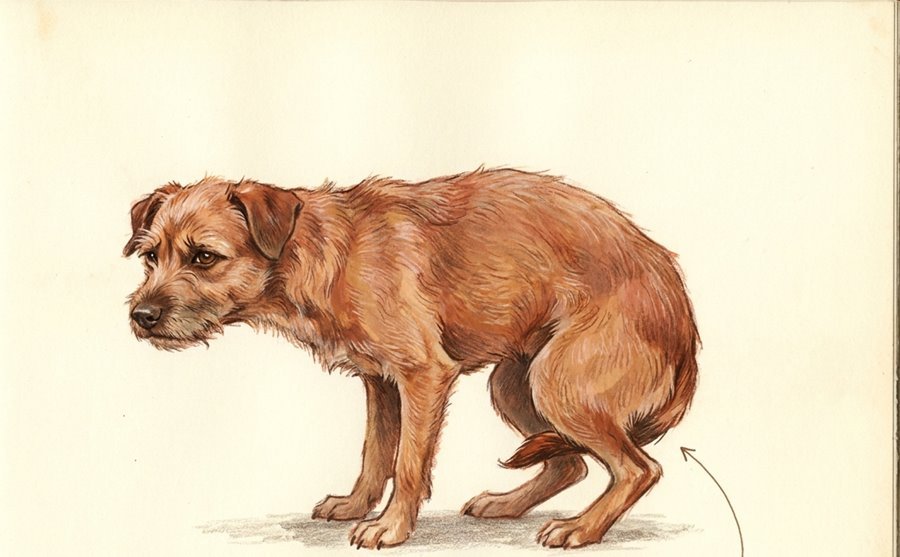
A tail clamped tight against the belly usually signals fear, anxiety or appeasement, and it goes with an attempt to increase distance from something. Pain and cold can produce the same shape, so read the whole dog. Stop whatever is causing it, give room, and let the dog choose to approach. Comforting does not reinforce fear.
What it looks like
The tail is pressed against the belly or curled forward between the hind legs, not merely hanging low. The rear may drop, the back round, and the hind legs draw under the body. Usually the whole outline shrinks: head lowered, ears back or flat, weight shifted away from whatever the dog is watching. The tail often stays pinned there without moving at all.
What it often means
Fear or anxiety. The tuck sits among the distance-increasing behaviours a dog offers on the lower rungs of the ladder of aggression, well before anything louder.
Appeasement. Paired with a lowered body, an averted gaze and a low, fast wag, the tuck accompanies an attempt to defuse a social situation rather than outright terror. Rugaas is practitioner-derived and not peer-reviewed, so the weight of this reading rests on the clinical literature.
Pain or illness. Dogs in discomfort commonly adopt tucked, hunched postures, and pain is a frequent and under-recognised contributor to sudden behaviour change.
Learned anticipation. Places where something unpleasant happened before, such as a clinic corridor or a grooming table, can produce the full posture with nothing threatening present now. Clinic scales for fear, anxiety and stress treat this level of display as a point to slow down.
Cold alone. A shivering dog in wind or rain may be conserving heat rather than signalling anything. This one rests on ordinary clinical reasoning rather than any study of tail carriage, so treat it as a differential to rule out, not an explanation to reach for.
How readily a dog tucks depends on temperament, learning history and tail conformation, and breed predicts very little about any individual. Some dogs tuck at a doorbell; others only in the consulting room.
What it does not mean
- A tucked tail is not guilt. When the guilty look was tested experimentally it tracked the owner's scolding rather than whether the dog had done anything, and it appeared just as readily in innocent dogs. The study scored a cluster of behaviours rather than the tail alone.
- It is not stubbornness, drama, or something to correct. Confrontational and aversive handling of a frightened dog is associated with more aggressive responses and poorer welfare.
- It does not mean the dog is submitting to a pack leader. Dominance-based explanations of pet dog behaviour are not supported by the wolf research they came from, nor by studies of dogs themselves.
What changes the reading
| When | Effect on the reading |
|---|---|
| Veterinary clinic or grooming salon | Tucking is common here and predicts low tolerance for handling. Ask for a slower, food-based approach, or discuss pre-visit medication, rather than pushing through. |
| Fireworks, thunder or building work | Expect tucking with pacing, hiding and panting. A dark, quiet place the dog chooses for itself is more use than encouragement to come out. |
| A child is approaching, or has just been near | Stop the approach and separate them calmly. This is the stage where intervention costs nothing, and a cornered frightened dog is a bite risk. |
| The tuck is new, constant, or paired with reluctance to sit, jump or climb stairs | Book a physical examination before starting behavioural work. |
| Cold, wet or windy weather with a thin-coated dog | Weigh cold as a plain physical explanation. Check whether the tuck disappears indoors within a few minutes. |
| The dog is on lead, in a corner, or held for handling | Escape is unavailable, so the tuck can escalate quickly. Release the pressure, drop the lead tension and open a route away. |
Read the whole dog
Seen together, these strengthen it
- Ears flattened or pinned back
- Whites of the eyes showing in a crescent
- Lip licking or yawning with no food and no tiredness
- Weight shifted back, or a crouch
- Moving away, hiding, or trying to get behind you
Seen together, these point elsewhere
- Loose, bouncing movement and a play bow
- Taking food readily and gently
- The tail lifting the moment the trigger leaves the room
- Cold, wet weather with a shivering, thin-coated dog
- A stiff or careful gait, or a recent injury
How confident we are
The fear reading is well described clinically, but the ladder is a teaching model rather than a measured sequence, and dogs skip rungs. Separating fear from pain from cold by eye is genuinely hard, and there is no threshold that tells you how tucked counts as tucked. Baseline carriage varies between individuals more than most charts admit.
Safety
Common questions
Does a tucked tail mean my dog feels guilty?
No. When researchers tested the guilty look, it appeared in response to the owner's scolding rather than to whether the dog had actually disobeyed. A tucked tail with a lowered head is appeasement aimed at the person standing there now. It tells you about this moment, not about the chewed shoe.
Will comforting my dog make the fear worse?
No. Fear is an emotional state, not a behaviour you can reward into existence, and calm company does not train a dog to be more afraid. What matters more is removing or reducing the trigger. If your presence lets the dog settle, stay; if the dog moves away from you, let it go and give it a quiet place.
My dog only tucks at the vet. Is that a problem?
It is worth acting on. A dog that tucks in the clinic is already near the top of its tolerance, and each frightening visit tends to make the next one worse. Ask for a low-stress handling approach, bring high-value food, request a quieter appointment slot, and discuss pre-visit medication with your vet.
Can a tucked tail ever be normal?
Briefly, yes. Many dogs tuck for a second when startled, then recover within moments and go back to sniffing or playing. The recovery is the useful part. A tuck that persists after the trigger has gone, or that shows up in ordinary situations at home, is worth investigating rather than accepting.
Sources for this entry
Every claim above is graded. Open the source register for the full citation, what it actually establishes, and its limits.
Practical guides
Longer, practical write-ups on the everyday side of this.
See it in context
A single signal is never enough on its own. Put this one together with the rest of what you are seeing, and the interpreter will show you the reasoning and how confident it is.
Method last updated . Built from and checked against the sources listed above. Think we got this wrong?