
Hard stare: a fixed, unblinking gaze
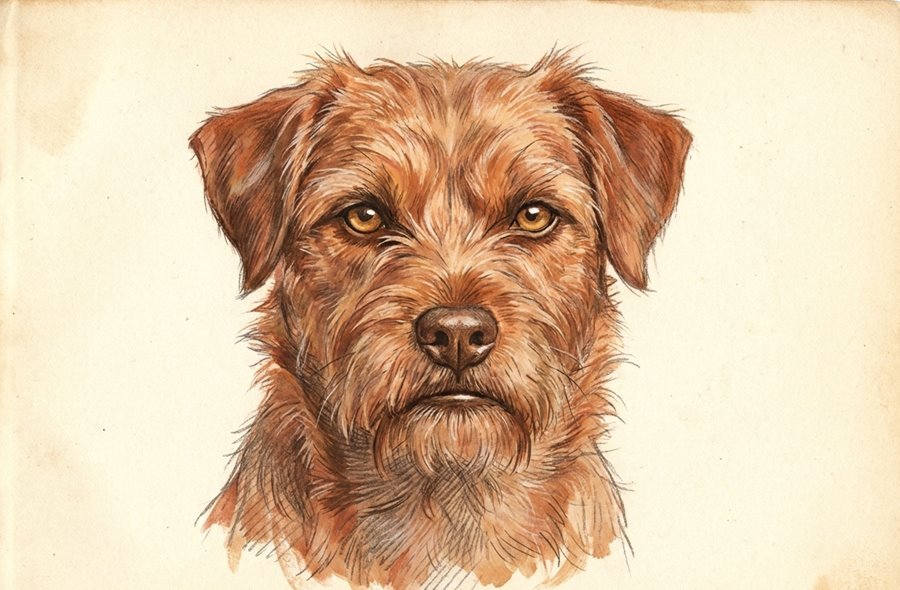
A hard stare is a still, unblinking gaze held on one target while the body tenses. It usually works as a warning to stop or stay back, sitting just below growling on the clinical escalation ladder. It is not a bid for rank, and the safest reply is to look away and add distance.
What it looks like
The eyes are wide open with the lids tightened, and blinking stops or slows to almost nothing. The pupils may look large, although light alone does that too. The head points at the target and stays there. The body usually goes still with the weight forward, the mouth closes, and the tail is high and either motionless or vibrating in a small fast wag. Movement of any kind is reduced across the whole dog.
What it often means
A distance-increasing warning. On the clinical escalation ladder a hard stare over a stiff body sits immediately below growling, above the subtler avoidance signals and below snapping and biting.
Guarding of an item, a resting place or a person, where the stare tracks an approach and stops when the approach stops.
Predatory or prey-driven focus on movement. It looks similar but is aimed at squirrels, bikes, joggers or livestock rather than at a social partner, and usually comes with creeping or leaning forward.
Intense but non-hostile attention: a trained dog watching a handler for a cue, or a dog fixed on a treat pouch. The distinguishing features are a loose body and easy blinking.
Pain showing itself as a shorter fuse. New staring or guarding in a dog who used to tolerate approach deserves a physical explanation first, since pain is a recognised and under-detected contributor to behaviour change.
Arousal tells you the intensity, not the flavour. The same fixed gaze can sit at the top of excitement or the top of threat, and the rest of the body decides which.
What it does not mean
- A hard stare is not the dog claiming to be pack leader or testing your authority. Wolf alpha hierarchies were misdescribed, and research on domestic dogs does not support a rank-driven model of everyday conflict.
- Staring back to win is not a technique. Confrontational responses such as staring down, alpha rolls and physical corrections are associated with aggressive responses from a sizeable minority of dogs in owner surveys, and with poorer welfare in controlled work.
- Breed does not tell you whether a stare is dangerous. Genetic work finds breed a weak predictor of individual behaviour, so read the dog in front of you rather than the label.
What changes the reading
| When | Effect on the reading |
|---|---|
| The stare is aimed at a person and paired with a stiff, forward-leaning body | Treat it as a serious warning. Stop moving, avoid direct eye contact, and back away slowly without turning it into a chase. |
| The dog is over food, a chew, a bed, or a person's lap | Do not reach in. Withdraw and manage the environment; guarding responds to space and trades, never to confrontation. |
| The stare is aimed at a squirrel, bike or jogger from a low, creeping posture | This is predatory focus rather than social threat. Add distance and interrupt early, before the fixation deepens. |
| The dog is behind a fence or window, or on a tight lead | Barrier frustration inflates both the stare and the noise. Judge the dog again with the barrier removed before drawing conclusions. |
| Onset is recent in a previously easy-going dog | Pain is a common driver of new irritability and guarding. Book a veterinary examination before starting behaviour work. |
| The dog is deaf, partially sighted, or elderly | Prolonged looking may be sensory checking rather than threat. Tension in the mouth and body is what tells them apart. |
Read the whole dog
Seen together, these strengthen it
- Body freeze with the weight shifted forward
- Closed, tight mouth and a wrinkled muzzle
- Low growl, or a lip lifted at the front
- Tail high and stiff, or a fast small wag at the tip only
- Hackles raised over the shoulders or rump
- The dog positioned over an item, or between you and something
Seen together, these point elsewhere
- Soft blinking with a mouth that stays open and loose
- Play bow, rear-end wiggle, or a bouncy approach
- The gaze breaking easily when you speak
- A wide, loose, whole-body wag and a curved approach
How confident we are
No experiment measures how often a hard stare precedes a bite, so its warning value comes from clinical consensus rather than counted outcomes. Separating threat focus from predatory or trained focus depends on body cues that are easy to misjudge in a still photo. Arousal frameworks describe intensity well but do not identify emotion on their own.
Safety
Common questions
My dog stares and growls when he is on the sofa. What should I do?
Stop approaching him there and manage the space for now. Call him off the sofa with a treat tossed away from it rather than reaching for his collar. Guarding is about keeping something valuable, not about rank, and it gets worse under confrontation. Book a veterinary check for pain, then work with a force-free behaviourist.
How is a hard stare different from my dog watching me for a treat?
The eyes look similar; the rest of the dog does not. Treat-watching comes with a loose body, easy blinking, an open mouth, shifting feet, and a dog who breaks off when you speak. A hard stare comes with stillness, a closed mouth, tension through the shoulders, and a gaze that does not release.
Should I stare my dog down to establish dominance?
No, and the dominance model behind that advice does not hold. The wolf research it came from was corrected by its own author, and studies of pet dogs find everyday conflicts are not driven by rank. Staring down is confrontational, and owner surveys record aggressive responses to it in a sizeable minority of dogs. Look away and add space instead.
Why does my dog hard-stare at other dogs on lead but not off lead?
The lead removes the option to move away or to greet in a curve, so tension has nowhere to go. Many dogs look far more confrontational on lead than they behave off it. Increase distance, let your dog turn away, and reward looking back at you before the stare locks on.
Sources for this entry
Every claim above is graded. Open the source register for the full citation, what it actually establishes, and its limits.
Practical guides
Longer, practical write-ups on the everyday side of this.
See it in context
A single signal is never enough on its own. Put this one together with the rest of what you are seeing, and the interpreter will show you the reasoning and how confident it is.
Method last updated . Built from and checked against the sources listed above. Think we got this wrong?