
Belly up
Rolling over is not one signal. A loose, wriggling dog with a soft face is often inviting contact. A stiff dog holding the position, tail clamped and head turned away, is more often asking for the interaction to stop. The difference is muscle tone, not the posture itself.
What it looks like
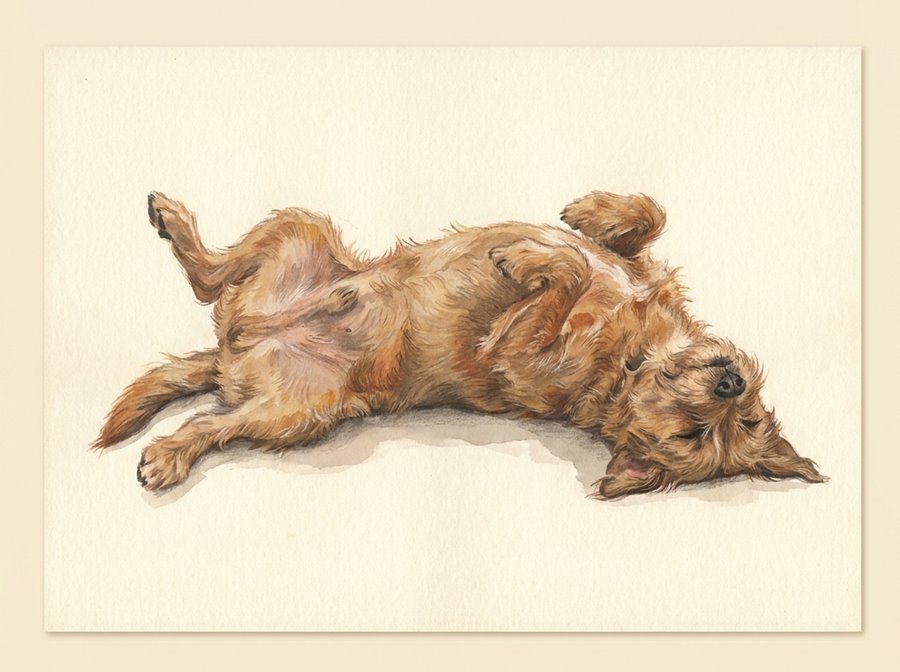
The dog is on its back or rolled onto one hip, belly and groin exposed. Check three things. The limbs: flopping loosely to the side, or held stiff and drawn in. The head: rolled back with the throat exposed and the mouth loose, or tucked and turned away with the whites of the eyes showing. The tail: sweeping across the floor, or clamped tight over the belly. Note also whether the dog rolled while moving toward you or while backing away.
What it often means
A loose roll with limbs flopping, a soft open mouth and a tail sweeping the floor, offered in a familiar place to a familiar person, goes with relaxed social solicitation. Contact is being invited rather than tolerated.
A rigid roll with the tail clamped over the belly, the head turned away and the whites of the eyes showing reads as appeasement. It is an attempt to switch off an approach that already feels like too much.
In play, rolling onto the back is a voluntary tactical move that both dogs take in turn. It belongs with the self-handicapping and role reversal that keep a game legible as play, alongside signals such as the play bow.
The roll appears under grooming, handling or veterinary restraint. There it reads as tolerance under pressure rather than enjoyment, and it is a cue to slow the handling down rather than press on.
Some dogs roll as a habit because it has reliably produced attention. Learning history shapes this heavily, so what the same posture means in one household can differ from the next.
What it does not mean
- It is not submission to you as pack leader, and it is not acceptance of your dominance. The rank framework behind that reading was drawn from captive wolves, corrected by the researcher whose early work popularised it, and is not supported by studies of domestic dogs.
- It is not an automatic request for a belly rub, and it is never consent from an unfamiliar dog. The appeasement version looks similar at a glance, and reaching into one is a common bite scenario, particularly for children.
- It is not guilt or an apology after a telling off. What looks like remorse tracked the scolding itself in controlled work, not any awareness of having done wrong.
What changes the reading
| When | Effect on the reading |
|---|---|
| The person approaching is a stranger, or is standing over the dog | Weight the appeasement reading much more heavily. Ask the person to step back, crouch side-on, and let the dog get up and choose whether to come over. |
| A child is leaning in or straddling the dog | Intervene now, calmly and without scolding either of them. Teach the child to stroke the chest or shoulder from the side, and never over a dog who is lying down or resting. |
| It happens at the vet, at the groomer, or during restraint | Treat it as tolerance rather than consent. Pause, reduce the handling, and rebuild it gradually with low-stress technique so the dog keeps the option to move. |
| It happens repeatedly during dog-dog play | Look for role swaps. If both dogs take turns and can break off, the play is balanced. If one dog is always on its back and cannot get up, separate them and give a break. |
| Rolling is new, reluctant, or the dog flinches when the abdomen is touched | Arrange a veterinary check. Abdominal, spinal and orthopaedic pain all change how willingly a dog goes onto its back. |
Read the whole dog
Seen together, these strengthen it
- A tail sweeping the floor rather than clamped over the belly
- Soft, blinking eyes and a loosely open mouth
- The spine wriggling, limbs falling loosely to the side
- The dog moved toward you before rolling, not away
- After you pause the stroking, the dog re-engages and asks for more
Seen together, these point elsewhere
- Whites of the eyes showing with the head turned away
- A closed, tense mouth and a tail clamped over the belly
- The body held rigid, limbs drawn in
- The roll happened as someone loomed over or reached down
- The dog stays motionless and does not re-engage when you stop
How confident we are
There is no experiment that cleanly separates an inviting roll from an appeasing one. The distinction rests on clinical description and on muscle tone, which is a judgement call under pressure. Play research documents rolling as a tactical move, but the same posture serves several purposes, and an individual dog's learning history often matters more than any general rule.
Safety
Common questions
How do I know if my dog actually wants a belly rub?
Use a short consent test. Stroke the chest or belly for about three seconds, then take your hands away and wait. A dog who wants more will move back into your hand, nudge, or roll further over. A dog who stays still, gets up, or turns the head away has declined, and that is worth respecting.
My dog rolls over the moment visitors arrive. Is that a problem?
It depends on how it looks. A loose, wriggling roll toward the visitor with a sweeping tail reads as excitement and social solicitation. A quick, stiff roll as the visitor looms over, with the tail clamped and the head turned away, reads as a request for less pressure. Ask guests to sit down, ignore the dog at first, and let it approach in its own time.
Should I roll my dog onto his back to show him I am in charge?
No. The alpha roll comes from a misreading of captive wolf studies that the original researcher publicly corrected, and forcing a dog onto its back is confrontational handling. Survey work links that kind of handling to aggressive responses from the dog. There is nothing it achieves that management and reward-based training cannot achieve more safely.
Sources for this entry
Every claim above is graded. Open the source register for the full citation, what it actually establishes, and its limits.
Practical guides
Longer, practical write-ups on the everyday side of this.
See it in context
A single signal is never enough on its own. Put this one together with the rest of what you are seeing, and the interpreter will show you the reasoning and how confident it is.
Method last updated . Built from and checked against the sources listed above. Think we got this wrong?