Body and posture
A dog's trunk shows two things you can check in a second: how much muscle tension is present, and whether the weight is shifting toward something or away from it. Together these usually narrow the picture, though no single posture carries a fixed meaning, so read the face and tail too.
What it looks like
Look at the trunk from shoulder to hip, in profile if you can. Note whether the topline is level or curved, whether the legs are straight under the body or splayed, and where the weight sits: over the front feet, evenly, or shifted back over the hocks. Note the height of the head relative to the shoulders, whether the dog is moving or holding still, and whether the coat along the spine lies flat or stands up.
What it often means
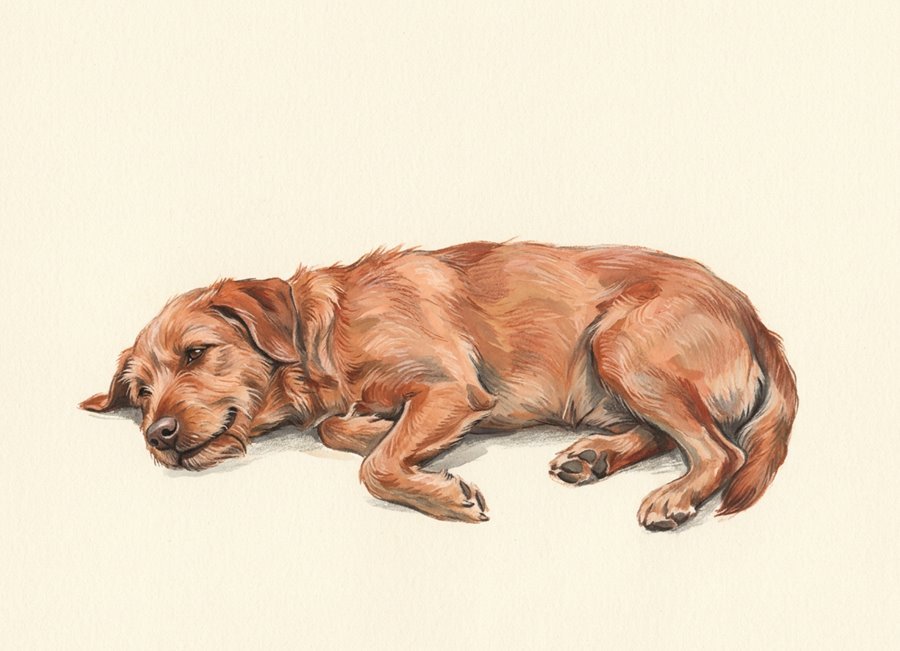
Even weight, curves rather than angles in the outline, and unhurried movement go with low arousal and comfort. This is the baseline everything else is measured against, which is why it repays watching on your own dog on an ordinary evening when nothing at all is happening.
Stiffness with the weight carried forward over the front feet is described in clinical texts as distance-increasing: the dog is asking for the approach to stop. In the ladder of aggression it sits near the top, so quieter signals have usually come first, though that ladder is a teaching model rather than a fixed sequence. The same outline also appears in intense interest and predatory focus, so treat it as high stakes either way and give space.
Weight shifted back, a lowered topline or a crouch goes with fear-related states, especially alongside a tucked tail and flattened ears. The outline gets smaller and the weight commits to the direction the dog would take if leaving were an option.
A changed posture is physical rather than emotional. Pain is frequently involved in dogs presented for behaviour problems and is easy to miss, because dogs carry on regardless and owners read the result as mood or stubbornness.
Practitioner accounts describe dogs curving their line of approach and turning the body side-on to lower social pressure. That work is practitioner-derived rather than peer-reviewed, so treat it as a useful field observation to test against your own dog rather than an established finding.
What it does not mean
- A tall, forward posture is not a dog claiming rank over you. The wolf-pack model behind that idea was corrected by the researcher whose early work popularised it, and studies of domestic dogs give no support for a fixed hierarchy that a person has to enforce.
- A low, slinking body when you come home to damage is not guilt or a confession. In controlled work that appearance tracked being scolded rather than whether the dog had actually done anything.
- A loose body is not blanket permission. It describes this moment only, and it can change within a single stride once hands, leaning or restraint arrive.
- A breed label does not tell you how to read the dog in front of you. Breed accounts for very little of the behavioural variation between individual dogs, so the posture you can actually see outranks any expectation you brought with you.
What changes the reading
| When | Effect on the reading |
|---|---|
| Food, a chew, a toy or a favourite resting place is within reach | Stillness, a body angled over the item, or weight held forward becomes far more likely to be resource-related. Step back and manage access rather than reaching in, and get force-free professional help if it happens more than occasionally. |
| The dog is on lead, cornered, or behind a barrier | Retreat is unavailable, so a dog who would have moved away may hold position or move forward instead. Read this as fewer options, not more confidence. |
| The change appeared suddenly, the dog is older, or it shows on one side only | Arrange a veterinary examination before any behavioural interpretation. Posture is often the first place orthopaedic or internal pain becomes visible. |
| The coat is long, thick or very dark | Tension is hard to see in outline. Judge from movement quality, breathing and where the feet are planted rather than from silhouette. |
| A child is nearby | Any tense posture warrants separating them now and supervising properly afterwards, because children tend to close distance at exactly the moment a dog is asking for space. |
Read the whole dog
Seen together, these strengthen it
- A hard stare held on one point while the body stays still
- A mouth that closes as you approach, with tight lips
- Weight braced over the front feet, feet planted rather than shifting
- Tail held high and rigid, or clamped tight and motionless
- Whites of the eyes showing while the head stays turned away
- A low growl, or breathing that seems to be held
Seen together, these point elsewhere
- Weight redistributing often, with the feet shifting freely
- Ears and tail moving with the body rather than held rigid
- Movement that curves rather than travelling straight at the target
- The dog breaks off to sniff or walk away, then chooses to come back
- A play bow immediately before or after the moment that worried you
- Panting with a lowered body in heat or straight after exercise
How confident we are
Most postural reading comes from clinical texts and structured observation rather than controlled experiment. There is no validated coding scheme for the trunk comparable to DogFACS for the face, the ladder of aggression is a teaching model whose exact order is not experimentally fixed, and conformation and coat differ so much between individuals that breed offers little predictive help.
Safety
Common questions
How can I tell tense from relaxed if my dog has a thick coat?
Watch movement rather than outline. A tense dog moves in straighter lines, changes direction less, and holds still longer between movements. Look at the feet: braced and planted rather than shifting. Breathing, and whether the dog can break off to sniff, tell you more than the silhouette of a fluffy body.
Which signal do I trust when the tail and the body disagree?
Trust the cluster, not the loudest part. When the tail reads one way and the trunk another, the honest reading is conflict, which is common and worth respecting rather than testing. Give space, stop whatever is applying pressure, and watch what the dog does once it can freely choose.
Is a dog standing tall over another dog being dominant?
Standing tall over another dog shows arousal and a claim on space in that moment, not a rank the dog carries around. Work on domestic dogs does not support a stable pack hierarchy that owners must enforce, and survey data links confrontational handling to aggressive responses. Interrupt calmly, separate the dogs, and give both a break.
Sources for this entry
Every claim above is graded. Open the source register for the full citation, what it actually establishes, and its limits.
Practical guides
Longer, practical write-ups on the everyday side of this.
See it in context
A single signal is never enough on its own. Put this one together with the rest of what you are seeing, and the interpreter will show you the reasoning and how confident it is.
Method last updated . Built from and checked against the sources listed above. Think we got this wrong?