
Raised hackles
Raised hackles are piloerection, an involuntary reflex driven by the same arousal system as a racing heart. They usually signal a jump in arousal, but not which emotion sits behind it, since fear, excitement and play all produce them. The rest of the body carries the direction.
What it looks like
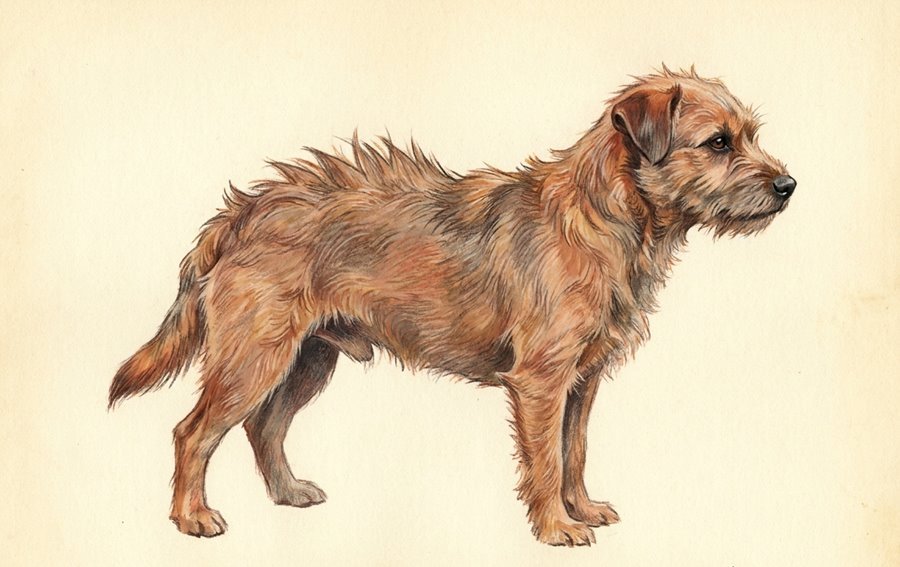
A strip of hair standing up along the back. The pattern varies: over the shoulders only, a patch at the base of the tail only, a continuous ridge from neck to tail, or an hourglass shape with a gap over the middle of the back. The raised hair stands roughly perpendicular to the skin, so the strip looks darker, wider, or spiky against the rest of the coat. It appears within seconds and flattens gradually rather than instantly.
What it often means
Piloerection reflects a rise in arousal driven by sympathetic activation. It reports intensity rather than pleasantness: something has moved the dog well off baseline, and the body has responded before any decision is made.
The same ridge appears in frightened, defensive dogs and in confident forward ones. Because it spans that whole range, it cannot on its own separate a dog who wants distance from one who is closing in.
Hackles rise in excited greeting and in play, particularly in young dogs and at the first moment of contact. Bouncy, curved, deliberately inefficient movement alongside the ridge points to arousal without threat.
The ridge lags behind the rest of the dog. Clinical accounts describe hackles still standing after the posture has loosened, because arousal settles more slowly than a stance changes. Treat it as a sign the dog is not yet back to baseline.
Threshold and visibility differ enormously. Some dogs raise hackles at almost any novel sight, others hardly ever, and coat type decides whether you can see it at all. Breed predicts individual behaviour poorly, so do not read a ridge through a breed stereotype.
What it does not mean
- Hackles do not mean aggression or an imminent bite. Piloerection reports arousal level, not intent. Direction, where it can be read at all, sits in the eyes, mouth, weight distribution and tail.
- It is not dominance, and it is not a dog deciding to look bigger. The reflex is not under voluntary control, so there is no decision there to challenge or correct.
- Charts that map hackle patterns onto specific emotions, shoulders for one state and a full ridge for another, have no published validation we can point to. Facial movement has a validated coding system; piloerection patterns do not.
- It is not something to interrupt with a correction. Punishing a dog at the moment of high arousal adds an unpleasant association to whatever triggered it, and aversive methods are linked to poorer welfare outcomes.
What changes the reading
| When | Effect on the reading |
|---|---|
| Meeting an unfamiliar dog on lead | Keep the greeting short and the lead loose, then move on. Lead tension and a head-on approach add arousal to a dog who is already above baseline. |
| A novel object, a sudden noise, or an unfamiliar person appeared | Increase distance and let the dog look from where it can cope. Most ridges settle within a minute or two once the dog is no longer being asked to close in. |
| It happens during play with a familiar dog | Judge the play, not the ridge. Role swaps, pauses and both dogs choosing to re-engage mean it is going well. If neither dog can break off, call a short break. |
| Fear signals are present as well: tucked tail, pinned ears, crouched body | Read it as a frightened dog at high arousal. Give space, do not hold the dog in place, and let it retreat rather than waiting for it to habituate. |
| The threshold has recently dropped, with hackles now rising at things that never triggered them | Arrange a veterinary examination. Pain lowers tolerance broadly, and a sudden change in reactivity deserves a medical look before a training plan. |
Read the whole dog
Seen together, these strengthen it
- Pupils appearing large, with a wide-eyed look
- Panting when the dog is neither hot nor recently exercised
- A tight, closed mouth and a rigid trunk
- Tail carried high and stiff, or held clamped and still
- Sudden barking or a growl beginning at the same moment
Seen together, these point elsewhere
- A play bow before or after the ridge appears
- Bouncy, exaggerated, inefficient movement
- A loose curved body and a soft, open mouth
- The dog can break off, sniff, and come back on its own
- The ridge settling within seconds as the dog turns away
How confident we are
Piloerection in dogs has attracted very little direct experimental study. What is written about it, including here, is drawn from clinical texts and physiological inference rather than measurement. The widely shared claim that hackle patterns map onto particular emotions has no published validation we can point to, and coat type alone decides whether you can see it.
Safety
Common questions
Do raised hackles mean my dog is about to attack?
Not on their own. Piloerection reports how aroused the dog is, not what will happen next, and it appears in frightened dogs as well as in forward ones. Look at the eyes, mouth, weight and tail for direction. Hackles plus a hard stare, a stiff forward body and a low growl is the combination that warrants stopping.
My dog's hackles go up when playing with other dogs. Should I stop the play?
Usually not by itself. Play raises arousal, and arousal raises hackles, so a ridge during a good game is common. Watch instead for role swaps, pauses, and both dogs choosing to re-engage. If the play has become one-directional, or neither dog can break off, call a short break rather than ending the session.
Can I train my dog out of raising hackles?
No, and it is not a fault to train away. Piloerection is a reflex, in the same family as a racing heart, so there is nothing for the dog to choose differently. What can change is the feeling that produces it, through distance, gradual exposure at a level the dog can cope with, and reward-based work.
Sources for this entry
Every claim above is graded. Open the source register for the full citation, what it actually establishes, and its limits.
Practical guides
Longer, practical write-ups on the everyday side of this.
See it in context
A single signal is never enough on its own. Put this one together with the rest of what you are seeing, and the interpreter will show you the reasoning and how confident it is.
Method last updated . Built from and checked against the sources listed above. Think we got this wrong?