
Yawning in dogs
A yawn away from sleep or waking often accompanies mild tension rather than tiredness, and it sits on the lowest rungs of the published ladder. Contagious yawning from a familiar person is a reported alternative explanation, so read it alongside the eyes, ears and posture, and note whether it repeats.
What it looks like
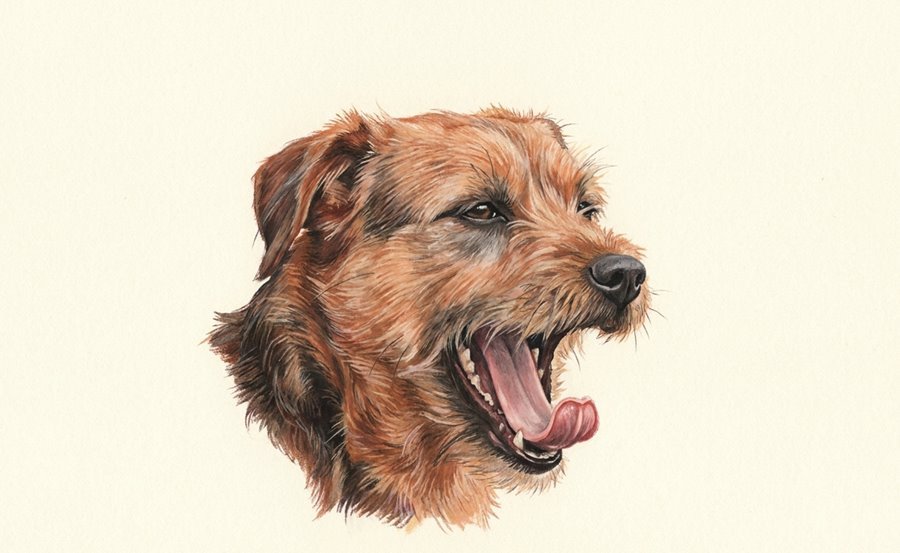
The mouth opens wide and slowly, the head often tips up or slightly to one side, the tongue may curl, and the eyes narrow or close. Some yawns are long and finish with a full stretch or a shake-off. Others are shorter, sometimes cut off part-way, and come again within a minute while the body stays still.
What it often means
Away from sleep, it appears in situations of mild conflict or discomfort, and it features on the lower rungs of the published ladder of aggression alongside lip licking and looking away.
Practitioner literature describes yawning as a calming signal offered to defuse social tension. This account comes from Rugaas's field observation and is practitioner-derived rather than peer-reviewed, so hold it lightly.
Some yawns are catching. In one study dogs yawned more in response to a familiar person's yawn than a stranger's, so a yawn that follows yours may be an echo rather than a report on the dog's own state. Replication across studies has been mixed.
On waking, after rest, or at the end of a stretch, it is ordinary physiology and needs no behavioural reading at all.
In clinics, during restraint or in the car, yawning clusters with lip licking and gaze aversion, and handling scales treat that cluster as an early stress marker worth acting on before it grows.
Baseline yawning differs a great deal between individuals, breed tells you little about the dog in front of you, and arousal alone does not say whether the dog is enjoying the situation or enduring it.
What it does not mean
- A yawn is not automatic proof of stress. Dogs yawn on waking, after stretching, and sometimes by contagion from the people around them.
- It does not mean the dog is bored with you, being rude, or testing your authority. Wild wolf packs are family groups rather than rank-ordered rivals, dominance framings of everyday dog behaviour are unsupported, and training built on them is linked with poorer welfare.
- It is not permission to continue. A yawn during handling or training is early feedback, and working through it tends to push the dog up the ladder rather than settle it.
- A dog yawning after you tell it off is not showing remorse. Expressions in that moment respond to your behaviour, not to the dog's understanding of a rule.
What changes the reading
| When | Effect on the reading |
|---|---|
| Just woken, or after lying still for a while | Discount it, particularly if it ends in a stretch or a shake-off. |
| You or someone nearby yawned in the last half-minute | Contagion is a plausible explanation, especially with a person the dog is bonded to. Look for a second, independent signal before reading tension. |
| Veterinary waiting room, grooming table, nail clipping, or being held still | Treat it as an early stress marker. Slow down, add distance, and use food and choice rather than persistence. |
| Immediately before a training repetition or a greeting | The exercise is probably too hard, too long or too close to something worrying. Make it easier and shorter. |
| A child or a stranger is leaning in to greet the dog | Ask them to step back and let the dog approach in its own time. Yawning here is early feedback, and pressing on is how a low rung turns into a growl or a snap. |
| In the car, with drooling, a lowered head and frequent lip licking | Consider motion sickness or nausea alongside fear, and raise it with your vet. |
Read the whole dog
Seen together, these strengthen it
- Lip licking within a few seconds
- Looking away or turning the head aside
- Ears back, brow tense, body slowing
- A shake-off once the pressure ends
- The dog moves away when a route out is available
- It repeats two or three times in a minute
Seen together, these point elsewhere
- It followed sleep and ended in a long stretch
- You yawned first and the dog was watching you
- The body stays loose and the dog immediately re-engages
- A single yawn in an otherwise mobile, relaxed dog
How confident we are
Yawn frequency has no validated cut-off. Contagious yawning in dogs has been reported, but replication across studies is mixed, so a yawn that follows yours is suggestive rather than proven. The calming-signal reading is practitioner-derived from Rugaas rather than experimental, and individual baselines vary enough that your own dog's normal rate matters more than any general rule.
Safety
Common questions
Why does my dog yawn when he isn't tired?
Most often because something in the moment is mildly uncomfortable or conflicting, and yawning is one of the low-cost things dogs do while they work out what to do next. Look at what changed in the ten seconds before it. If the answer is a hug, a stranger or a hard training exercise, ease off and give him room.
Do dogs catch yawns from humans?
There is experimental evidence that they do, and that it happens more readily with a familiar person than a stranger, although replication across studies has been mixed. It is one reason yawning is a noisy signal. Before reading stress into a yawn, check whether anyone nearby yawned first and whether the dog was watching at the time.
My dog yawns at the vet. Is he stressed?
Very likely, especially if it repeats and comes with lip licking, a lowered head or turning away. Clinics are one of the clearest places to see this cluster. Tell the team you want a slow approach, bring food he loves, and ask your vet about a pre-visit plan, which can include medication when the fear is significant.
Does yawning mean my dog is bored or being disrespectful?
Boredom is not a well-supported reading, and disrespect is not something dogs do. Frameworks built on dominance and status have not held up in the research on wolves or on domestic dogs, and training built on them carries real welfare cost. A yawn during training more often means the exercise is too hard, too long, or too close to something worrying.
Sources for this entry
Every claim above is graded. Open the source register for the full citation, what it actually establishes, and its limits.
Practical guides
Longer, practical write-ups on the everyday side of this.
See it in context
A single signal is never enough on its own. Put this one together with the rest of what you are seeing, and the interpreter will show you the reasoning and how confident it is.
Method last updated . Built from and checked against the sources listed above. Think we got this wrong?