
Lip licking and tongue flicks
A quick tongue flick with no food around is usually a low-level discomfort signal rather than hunger. It tends to arrive early, before clearer warnings, so it is worth catching. On its own it is weak evidence: read it against the rest of the body, and rule out mouth pain or nausea if it repeats.
What it looks like
The tongue comes out briefly and goes straight back in, often sweeping over the top lip or the nose, and sometimes only the tip shows at the front of the mouth. It can be a single flick or a run of them a second or two apart. Look for it while the head is still or turning away, with no food or drink present and nothing on the muzzle to clean off.
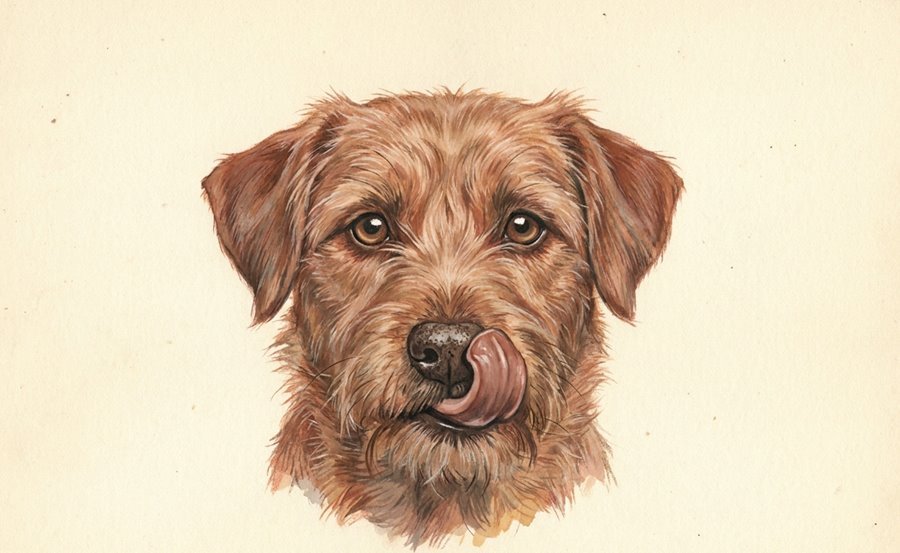
What it often means
With no food involved and a person or another dog close by, it behaves as an early, low-intensity signal. The published ladder of aggression places it on the bottom rungs, several steps before a growl.
It rises during handling, restraint, grooming, close approach to the face and hugging, and clinical handling guidance treats it as an early sign to slow down or stop.
It is described in practitioner literature as a calming signal offered to reduce social tension. That framing comes from Rugaas's field observation and is practitioner-derived rather than peer-reviewed, so hold it as a working idea rather than an established finding.
It is ordinary oral housekeeping: after eating or drinking, with food smells nearby, or alongside nausea, reflux and dental pain, which are common hidden drivers of behaviour change.
The same flick carries almost no weight in a loose dog sniffing on a walk, and a great deal on a consulting-room table. Stress scales place it in the low to moderate band, where the situation still decides the reading.
Some dogs flick at very low levels of tension while others skip it and go straight to stillness. Your own dog's baseline is far more informative than any breed generalisation.
What it does not mean
- It does not mean the dog is hungry or begging, unless food is genuinely present. A common misreading is to treat a social signal as an appetite one.
- It is not guilt or an apology. When tested directly, the guilty look appeared in response to being scolded, whether or not the dog had done anything.
- It is not consent to carry on. A dog that lip licks while being hugged or held is more likely tolerating the contact than enjoying it, even if it stays perfectly still.
- It is not defiance, stubbornness or a status move, and it should never be corrected. Dominance framings of ordinary dog behaviour are unsupported, and confrontational or aversive handling is linked to more aggressive responses and poorer welfare.
What changes the reading
| When | Effect on the reading |
|---|---|
| Food, treats, water or a strong smell nearby | Discount it. There is a simpler explanation and no need to read tension into it. |
| Nail trims, ear cleaning, veterinary handling, hugging or leaning over | Take it as real feedback. Pause, take your hands away, and let the dog reset before you continue or stop for the day. |
| A child is approaching, reaching for the dog's face, or leaning over it | Stop the approach and call the child back. Close face-to-face contact is a recognised bite context, and this flick is the cheapest warning you will get. Keep them apart until an adult can supervise properly. |
| Near food, a chew or a favourite resting place, with the body stilling over it | Stop approaching. Licking with stillness over a resource is an early guarding warning. Do not reach for the item, and arrange a swap-based plan with a qualified force-free behaviourist. |
| Repeated across calm and social contexts, with drooling, gulping or a change in eating | Book a veterinary check. Nausea, reflux and dental disease produce identical-looking flicks. |
| During training that uses a raised voice, lead checks, or a spray or shock device | Signals like this indicate the method itself is aversive. Change the method rather than pushing on. |
Read the whole dog
Seen together, these strengthen it
- A head turn or gaze aversion in the same second
- A yawn within a few seconds either side
- Ears drawn back with tension across the brow
- Whale eye, or a hard still stare
- Body slowing, freezing or shifting weight backwards
- The dog leaves when given a clear route out
Seen together, these point elsewhere
- Food, a treat or water present immediately before
- Directly after a meal, a drink or a hot walk
- Loose wagging, a wriggly body, and voluntary return for more contact
- It happens at the same rate in undemanding situations, which points to a personal habit or a medical cause rather than the moment
How confident we are
No published work establishes a threshold, so nobody can tell you how many tongue flicks per minute mean distress. The calming-signal framing comes from Rugaas's practitioner observation rather than peer-reviewed experiment. Baseline rates differ widely between individuals, and mouth pain, nausea and drooling produce identical-looking flicks.
Safety
Common questions
Why does my dog lick his lips when I pet him?
If no food is involved, it often means the contact is a little more than he wants at that moment. Use the consent test: stop stroking, take your hands back and wait. If he nudges your hand or leans in, carry on. If he stays still, looks away or moves off, he has answered, and the answer is worth respecting.
Does lip licking mean my dog feels guilty?
No. The guilty look was tested directly, and dogs produced it in response to being scolded, whether or not they had done anything wrong. A lip lick in that moment tracks your tone and posture rather than any memory of the chewed shoe. Clean up, then change the management so the situation cannot repeat.
My dog licks his lips constantly. Should I see a vet?
Yes, if it happens across calm and social situations alike, or comes with drooling, pawing at the mouth, gulping, a change in eating, or new sensitivity about the head being touched. Dental disease, nausea and reflux all produce frequent tongue flicks, and pain is a common hidden driver of behaviour change. Rule the body out before treating it as a training matter.
Is a tongue flick the same as my dog licking me?
They are different behaviours. Licking you is directed contact with a social origin, and it often strengthens into a habit through the attention it earns. A tongue flick is brief, self-directed and aimed at nothing. Judge them separately, since a dog can lick your hand happily and still flick its tongue when a stranger leans over it.
Sources for this entry
Every claim above is graded. Open the source register for the full citation, what it actually establishes, and its limits.
Practical guides
Longer, practical write-ups on the everyday side of this.
See it in context
A single signal is never enough on its own. Put this one together with the rest of what you are seeing, and the interpreter will show you the reasoning and how confident it is.
Method last updated . Built from and checked against the sources listed above. Think we got this wrong?