Pinned-back ears: flat against the head
Ears clamped flat against the skull usually signal fear or appeasement, especially with a lowered body and a tucked tail. Sometimes the cause is ear pain. It is a request for the pressure to ease, not an admission of guilt, and a frightened dog with no way out can still bite.
What it looks like
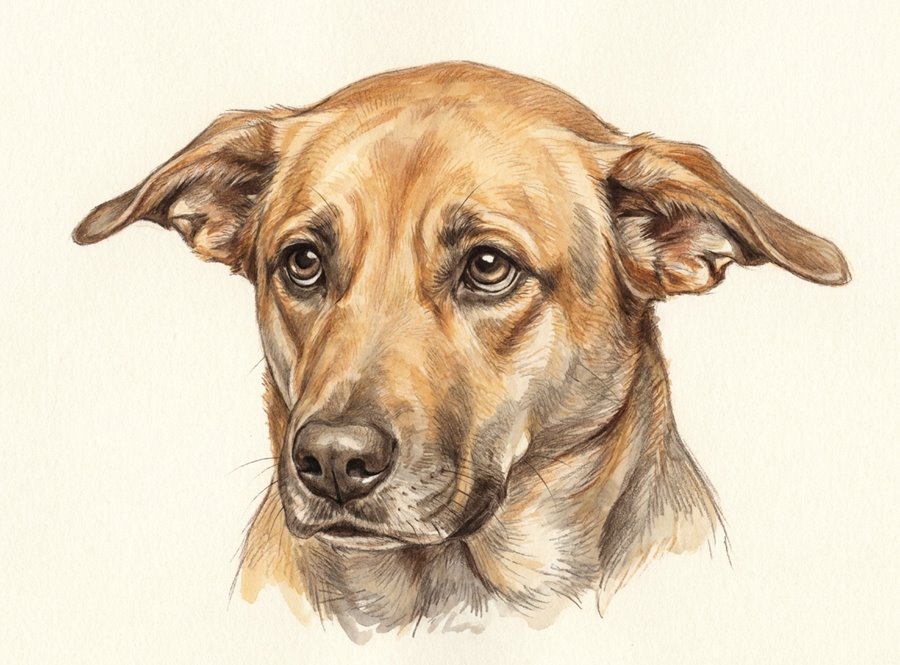
The ear base is pulled hard back and down so the ears lie tight along the skull, flattening the head's outline. On drop-eared dogs the flap presses against the neck rather than hanging free. The forehead skin usually looks stretched smooth. It typically appears with a lowered head, rounded back, tail low or tucked, a tight closed mouth or a wide pulled-back grimace, and a body that has stopped moving or is edging away.
What it often means
Fear or anxiety, particularly when combined with a lowered body, a tucked tail, and weight shifted away from whatever is happening.
Appeasement toward a person or another dog: an attempt to reduce social pressure and avoid conflict. Common during greetings from strangers, veterinary handling and grooming.
Part of a defensive cluster partway up the clinical escalation ladder. If the pressure continues, the next rungs are stiffening, growling and snapping, though not every dog climbs them in order and a dog punished for growling may skip that rung entirely.
Physical discomfort rather than emotion, including ear infection, a foreign body, or pain elsewhere in the body. Pain is a well-documented and under-recognised driver of behaviour change.
High positive excitement. Flattened ears also appear in fast greetings and in play, when the rest of the body is loose and bouncing and the dog offers play bows, which mark the exchange as play. Stress scales used in practice score the whole dog for this reason, never one feature.
Practitioner accounts include pinned ears among stress signals. That description is practitioner-derived rather than peer-reviewed, and should be weighed alongside the clinical literature.
What it does not mean
- Pinned ears are not guilt, remorse, or the dog knowing they did wrong. The guilty look appears in response to a person's tone and body language, including in dogs who did nothing at all.
- It is not submission to your authority in a rank sense. Work on domestic dogs does not support reading everyday appeasement as an acknowledgement of rank, and the alpha model behind that reading was publicly corrected by the wolf researcher who popularised it.
- Flat ears do not mean a dog has given in and is now safe to handle. A frightened dog with no escape route is one of the most common bite scenarios in clinical caseloads.
- It is not a sign to push on and get the job finished. Continuing to handle a dog who has flattened and frozen is how quiet tolerance turns into a bite, and forceful or aversive handling makes fear-related behaviour more likely, not less.
What changes the reading
| When | Effect on the reading |
|---|---|
| Fireworks, thunder, traffic or building noise | Likely noise fear. Offer a covered, quiet den space and let the dog choose it. For severe cases, discuss medication with your vet well before the next event. |
| Vet clinic, groomer, nail trims, or being lifted | Handling fear. Slow down, use food, let the dog stand and move away, and ask for low-stress handling techniques. |
| One ear only, or with head shaking, scratching, odour or a tilt | Treat it as a medical sign and book a veterinary examination before any behavioural interpretation. |
| Loose wiggly body, low fast wag, open mouth | Excited greeting rather than fear. The ears do not distinguish these two; the rest of the body does. |
| The dog is cornered, on a short lead, or held by the collar | Escape is blocked and bite risk rises sharply. Release the pressure and let the dog leave. |
| Puppies and adolescents meeting adult dogs | Flattened ears with a low, wiggly approach are normal appeasement and usually resolve on their own if the adult dog is tolerant. |
Read the whole dog
Seen together, these strengthen it
- Tail low or tucked between the legs
- Body lowered, crouched or hunched
- Whale eye, or wide staring eyes
- Lip-licking, yawning, or panting without heat or exercise
- Trembling, or moving behind a person or furniture
- Refusing food the dog normally takes readily
Seen together, these point elsewhere
- Loose, sweeping, whole-body wag
- Play bow followed by a bounce
- Soft open mouth with a relaxed tongue
- The dog returning voluntarily for more contact after a pause
- Taking food readily and eating normally
How confident we are
The fear reading is well supported clinically but rests on expert description, not on experiments that measure ear angle against physiological stress. The overlap with excitement is real and under-studied, and pain is a frequent confound that is easy to miss. Ear anatomy differs so much between dogs that pinned is a judgement against that individual's own baseline.
Safety
Common questions
Why does my dog pin his ears back when I come home?
Homecoming greetings often bring flattened ears with a loose wiggling body, a low fast wag, and a squinting face. That combination reads as excited appeasement rather than fear. Fear looks different: the body shrinks, the tail tucks, movement stops, and the dog avoids rather than approaches. The rest of the body settles it.
My dog pins her ears when I tell her off. Does she know she did wrong?
She is responding to you now, not to what happened earlier. When owners scold, dogs produce the flattened, lowered, appeasing display whether or not they actually did anything, which is what the guilty-look research found. Telling her off teaches her that your return is unpredictable. Manage the environment instead.
Is a dog with pinned ears safe to stroke?
Not necessarily, and it is the wrong question to answer from the ears alone. If the body is tense, the tail is low, and the dog is not moving toward you, leave them be. Let the dog come to you, stroke the chest or shoulder for three seconds, then stop and see whether they ask for more.
Can pinned ears mean my dog is in pain?
Yes, and it is worth taking seriously. Ear infections, foreign bodies and pain elsewhere in the body all change ear carriage, and pain is a recognised, often missed contributor to behaviour problems. Look for head shaking, scratching, odour, a head tilt, or reluctance to be touched around the head, and book a veterinary check.
Sources for this entry
Every claim above is graded. Open the source register for the full citation, what it actually establishes, and its limits.
Practical guides
Longer, practical write-ups on the everyday side of this.
See it in context
A single signal is never enough on its own. Put this one together with the rest of what you are seeing, and the interpreter will show you the reasoning and how confident it is.
Method last updated . Built from and checked against the sources listed above. Think we got this wrong?