Resource guarding
Guarding food, toys, beds or people is usually ordinary canine behaviour about keeping something valuable, not a bid for status. It is a request for distance, and it escalates from subtle signals to obvious ones. Punishing the early warning often removes the growl while leaving the worry, so bites arrive with less notice.
What it looks like
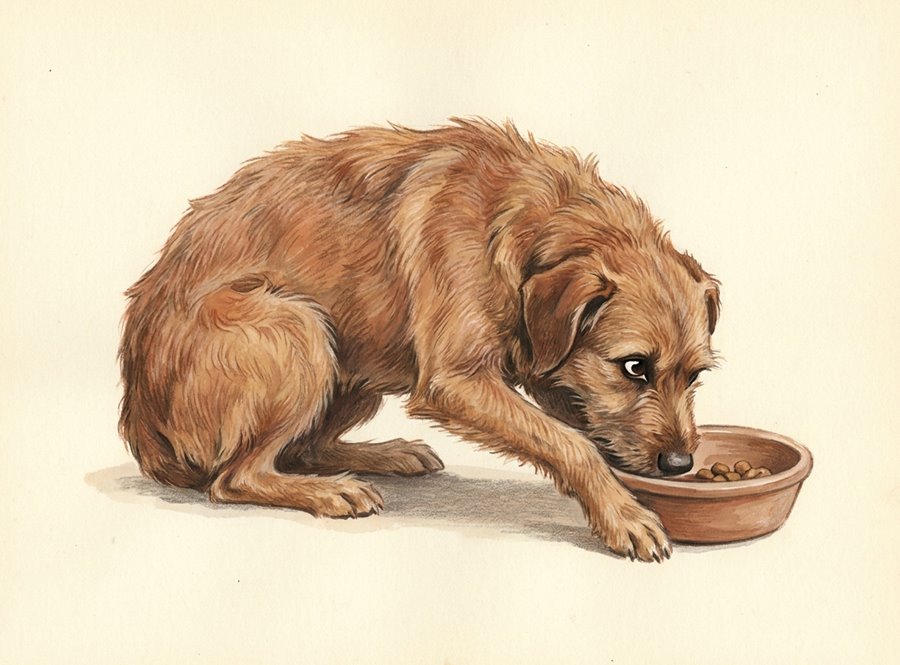
The dog is beside a bowl, a chew, a toy, a bed, a doorway or a person. As someone approaches, chewing speeds up or stops dead. The head lowers over the item, the body goes still, and the eyes swivel to track the person while the head stays down, showing a crescent of white at the inner corner. The lips may lift at the front. A low growl can follow, then a snap, then teeth on skin.
What it often means
A request for distance from the item rather than hostility towards the person. The behaviour is about keeping possession of something the dog values and expects to lose.
Part of a graded sequence. Faster eating, freezing, a head turn and a hard stare typically arrive before a growl, and a growl before a snap. The early rungs are the cheapest place to intervene.
Sharpened by experience. Clinical accounts describe guarding hardening in dogs whose items are repeatedly removed, and owner surveys link confrontational handling with aggressive responses, though survey data show association rather than proof of cause.
Value is set by the dog, not by the object's price. The same dog may ignore a full bowl of kibble and guard a tissue, a stolen sock or a warm spot on the sofa.
Raised by pain or illness. New or worsening guarding, particularly around beds, being touched or being lifted, is a recognised reason to investigate discomfort before starting behaviour work.
How readily a dog guards, and how fast it escalates, differs between individuals. Breed predicts an individual dog's behaviour poorly, so a breed label is not a risk assessment in either direction.
What it does not mean
- It does not mean the dog is trying to be dominant or become pack leader. Dominance explanations of household dog behaviour are not supported, and the wolf-pack model behind them was corrected by the researcher who popularised it.
- A growl is not disobedience or a broken bond. It is information that buys everyone time, and punishing it can suppress the warning while the worry stays exactly where it was.
- Taking food away, putting a hand in the bowl, or showing the dog that the food is yours does not teach acceptance. Confrontational techniques are linked to aggressive responses and to poorer welfare outcomes.
- It is not a verdict on your relationship. The same dog who stiffens over a chew may seek contact from you minutes later, because guarding is about the item and the expectation of losing it.
What changes the reading
| When | Effect on the reading |
|---|---|
| The dog guards from one household member only | Often this tracks how that person has handled the dog's things. Change the pattern: nobody takes, everyone trades, and that person becomes the one who walks past and adds food from a distance. |
| The dog freezes or stops eating while a person is still several steps away | That distance is already too close. Note where the line sits, stay outside it in daily life, and treat it as the starting point of any plan. |
| Guarding appears suddenly in an adult dog with no prior history | Book a veterinary appointment. Pain and illness are established contributors to new problem behaviour, and behaviour work built on untreated pain tends to fail. |
| There are children in the home | Manage first and manage completely. Feed and give chews behind a closed door or gate, and never leave a child and a guarding dog together unsupervised. |
| The dog guards a person rather than an object | The principle is identical and the management need is higher. Call the dog to you and reward before anyone approaches, rather than reaching for a collar or confronting the dog in place. |
| The dog has already been told off for growling | Expect less warning next time. Assume a shorter runway, raise management immediately, and get professional help rather than testing the dog to see what happens. |
| There are several dogs in the household | Feed in separate rooms and keep high-value chews out of shared space. Most fights over items are prevented by not staging the contest. |
Read the whole dog
Seen together, these strengthen it
- Body stillness and a pause in chewing as a person approaches
- Whale eye: the head held down over the item while the eyes track you
- Speeding up eating, or picking the item up and carrying it away
- A low growl that stops the moment you step back
- A stiff body curved around the item, sometimes with a lifted lip
- The behaviour switching off reliably once the person leaves the area
Seen together, these point elsewhere
- The dog picks the item up and brings it towards you
- Loose wagging that moves the whole rear as you approach
- The dog leaves the item to greet you, then returns to it
- Growling that continues when nobody is near the item, which points elsewhere, often to pain
- The dog pushing the object into your hands for a tug or fetch game
- A soft face and squinty eyes rather than a fixed stare
How confident we are
The ladder of escalation is a clinical teaching model rather than a measured sequence, and real dogs skip rungs, especially after their warnings have been punished. Prevalence figures vary with how guarding is defined and who is asked. Whether a given dog improves with behaviour work alone, or needs a pain investigation first, is often unclear until both are tried.
Safety
Common questions
Why does my dog growl when I go near his food?
Usually because he expects to lose it. Guarding is a request for distance from the item, and it is normal canine behaviour rather than a character flaw. The growl is the useful part: it is a warning that buys everyone time. Step back, stop approaching the bowl, and start trading for higher-value food away from mealtimes.
Should I take my dog's food away to stop resource guarding?
No. Repeatedly removing food teaches the dog that your approach predicts loss, which usually makes guarding worse. Survey work links confrontational methods to aggressive responses, and reviews of aversive training find poorer welfare outcomes. The safer approach is the opposite: walk past, drop something better into the bowl from a distance, and keep going.
Is resource guarding a sign of dominance?
No. Dominance explanations for household dog behaviour are not supported by the evidence, and the wolf-pack hierarchy they were built on was corrected by the researcher who popularised it. Guarding is about the value of the item and the expectation of losing it. Framing it as a rank contest leads to confrontation, which makes bites more likely.
My dog guards me from my partner, what does that mean?
Often proximity to you has become the valued resource, frequently where the dog has been moved, told off or interrupted near you. It is not jealousy in the human sense and not a loyalty statement. Manage it by not letting the scene repeat: call the dog off the sofa with a cue and a reward before anyone sits down.
Can resource guarding be fixed?
Often it improves a great deal, and good management can make daily life much safer straight away. Progress usually comes from changing what your approach predicts, not from confronting the dog. If your dog has bitten, if children live in the home, or if the guarding is new, involve your vet and a qualified force-free behaviourist rather than working alone.
Sources for this entry
Every claim above is graded. Open the source register for the full citation, what it actually establishes, and its limits.
Practical guides
Longer, practical write-ups on the everyday side of this.
See it in context
A single signal is never enough on its own. Put this one together with the rest of what you are seeing, and the interpreter will show you the reasoning and how confident it is.
Method last updated . Built from and checked against the sources listed above. Think we got this wrong?