Play bow
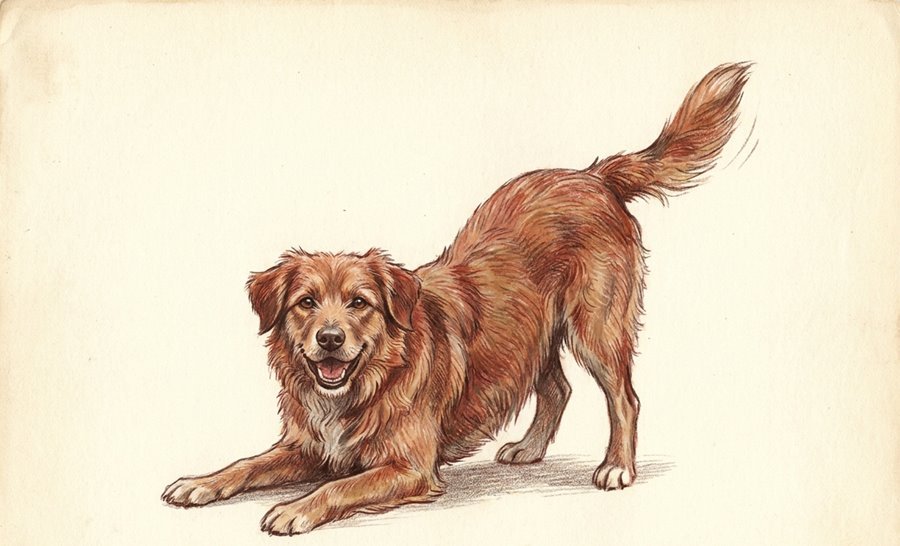
A play bow, front end down and rear high, is usually an invitation to play, and observational work describes it as a marker that what follows is play rather than conflict. It is not proof that both dogs are comfortable, so read the other dog's reply before relaxing.
What it looks like
The front legs fold to the ground so the elbows and forearms rest flat, while the hindquarters stay up over straight back legs. The chest drops low, the rump is the highest point, and the tail is usually raised and moving. The mouth is often open with the tongue loose and the corners drawn back long. The pose is brief, a second or two, and it usually repeats.
What it often means
An invitation to play, and a frame for what comes next: the biting, chasing and body slamming that follow a bow are play rather than conflict. Observational canid work describes the bow as a meta-signal covering the sequence, not only the next second.
A restart. In observational work, bows cluster around pauses and around moments when play has tipped towards rough, which fits the idea that the bow keeps an interaction going after a wobble.
Aimed at a person rather than a dog, as a request to start a game. Dogs learn readily that a bow at a human is followed by a thrown ball or a chase, so the posture is partly maintained by what it produces.
Wrapped in growling that is not a threat. Play growls differ acoustically from food-guarding growls, and dogs discriminated between the two in playback testing. Growling inside loose, bouncy play is therefore not automatically a warning, though the rest of the body still decides.
Bundled with appeasement or de-escalation after a misjudged move. Practitioner accounts group bowing with calming behaviour, and that framing is practitioner-derived rather than peer-reviewed, so treat it as a working idea rather than an established finding.
Whether the bowing dog is comfortable or simply very aroused depends on the rest of the body. Arousal and emotional valence are separate dimensions, and a high-energy dog is not automatically a happy one. The open-mouth, long-commissure play face is a codeable facial configuration worth checking alongside the posture.
A bow-shaped posture held repeatedly and for long stretches, in a dog who is otherwise off colour, can be a pain posture rather than a play offer. Pain is an established contributor to changed behaviour in dogs.
What it does not mean
- It is not a submission display or an admission of low rank. The wolf-pack hierarchy language that produced that reading was corrected by the researcher who popularised it, and dominance frameworks describe household dog behaviour poorly.
- It does not guarantee the other dog wants to play. A bow is an offer, and the reply is the information that matters. Bows aimed at a dog who is eating, chewing or resting are worth interrupting calmly.
- Not every bow-shaped posture is a play bow. A slow stretch on waking is held longer, often paired with a yawn, and aimed at nobody in particular.
- Rough, noisy play is not proof that a dog is aggressive or needs disciplining. Confrontational handling is linked to aggressive responses and to poorer welfare, so breaking up play with punishment raises risk rather than lowering it.
- It cannot be turned into words, and no app can convert it into a sentence. A bow reports a probable intention about the next few seconds, and nothing more specific than that.
What changes the reading
| When | Effect on the reading |
|---|---|
| The bow is followed by a chase in which only one dog ever does the running | Pause the game and check whether the chased dog chooses to come back. If it does not, the play is one-sided and should end. |
| Bows come with a hard fixed stare and a still body between bursts | Read the stillness, not the bow. Lower the arousal with distance and a break before anything continues. |
| The dog bows at a person while barking sharply and bouncing | Usually a demand for the game to start. Wait for four feet on the floor and a breath, then start it, so the bouncing is not what works. |
| Bowing is new, frantic, or paired with lameness, repeated stretching or a changed play style | Ask your vet about pain, particularly abdominal or musculoskeletal discomfort, before treating it as a behaviour problem. |
| A small dog bows at a much larger one | Watch for self-handicapping from the larger dog, such as lying down or slowing. Without it, a size mismatch turns play into pressure quickly. |
| The bow is offered to a dog behind a fence or on lead | Frustration can look like play. Barrier and lead greetings escalate faster than free play, so create distance rather than allowing a tight nose-to-nose meeting. |
Read the whole dog
Seen together, these strengthen it
- Loose, bouncy, exaggerated movement broken by frequent short pauses
- Role swaps: the chaser becomes the chased, the pinner becomes the pinned
- Self-handicapping by the bigger or faster dog, such as lying down or slowing
- An open mouth with the corners drawn back long and the tongue loose
- Both dogs choosing to return to each other after a break
- Growling that is short and pulsed, wrapped in bouncy movement
Seen together, these point elsewhere
- One dog repeatedly moving away, hiding behind a person, or trying to leave
- Stillness and a hard, fixed stare between bursts of activity
- Ears pinned flat, tail clamped, or a lip lifting between bows
- A body that gets tighter and faster rather than looser as play continues
- Bows aimed at a dog who is eating, chewing, or settled on a bed
- Yelping that does not pause the game
How confident we are
The meta-signal function of the bow rests on observational canid work rather than large controlled trials, and researchers still debate whether it mainly announces play, resets it after a pause, or helps coordinate position. Individual style varies widely: some dogs bow constantly, some almost never, and breed tells you little about which (morrill2022).
Safety
Common questions
Why does my dog play bow at me?
Usually it is an invitation to start a game, and dogs learn quickly that bowing at a person tends to produce one. Often it also follows a pause, as a way of restarting play that stalled. If the bowing is new, frantic, or paired with a dog who seems otherwise unwell, ask your vet about pain.
Is a play bow always friendly?
Mostly, but not automatically. The bow is an offer, and the reply carries the information. If the other dog turns away, freezes, or leaves, the offer has been declined and the bowing dog should be called away calmly. A bow aimed at a dog who is eating, chewing or resting is worth interrupting before it lands.
My dog play bows then growls, is that bad?
Often it is fine. Play growls tend to be shorter and higher pitched than guarding growls, and in playback tests dogs told the two apart. What matters is the frame around the sound: a growl inside loose, bouncy, role-swapping play reads differently from one that comes with a still body, a hard stare and a stiff tail.
What is the difference between a play bow and a stretch?
Timing and tempo. A play bow drops fast, holds for a second or two, and is aimed at someone. A waking stretch is slower, held longer, often paired with a yawn, and aimed at nobody in particular. A dog who repeatedly holds a bow-like stretch when nothing playful is happening should be checked for abdominal pain.
Can I play bow back at my dog?
You can, and many dogs answer a low, exaggerated bend with more play. Treat it as a game rather than a translation: you are copying a posture, not sending a sentence. If your dog backs off, stiffens, or looks away when you loom forward, stand up and offer a chase or a toy instead.
Sources for this entry
Every claim above is graded. Open the source register for the full citation, what it actually establishes, and its limits.
Practical guides
Longer, practical write-ups on the everyday side of this.
See it in context
A single signal is never enough on its own. Put this one together with the rest of what you are seeing, and the interpreter will show you the reasoning and how confident it is.
Method last updated . Built from and checked against the sources listed above. Think we got this wrong?