
The low warning growl: a request for space
A low, sustained growl is usually a request for distance, given instead of a snap or bite. For most dogs it is the most useful warning they have, and it works best when you answer it by backing away. Punishing it often removes the sound while leaving the feeling untouched.
What it looks like
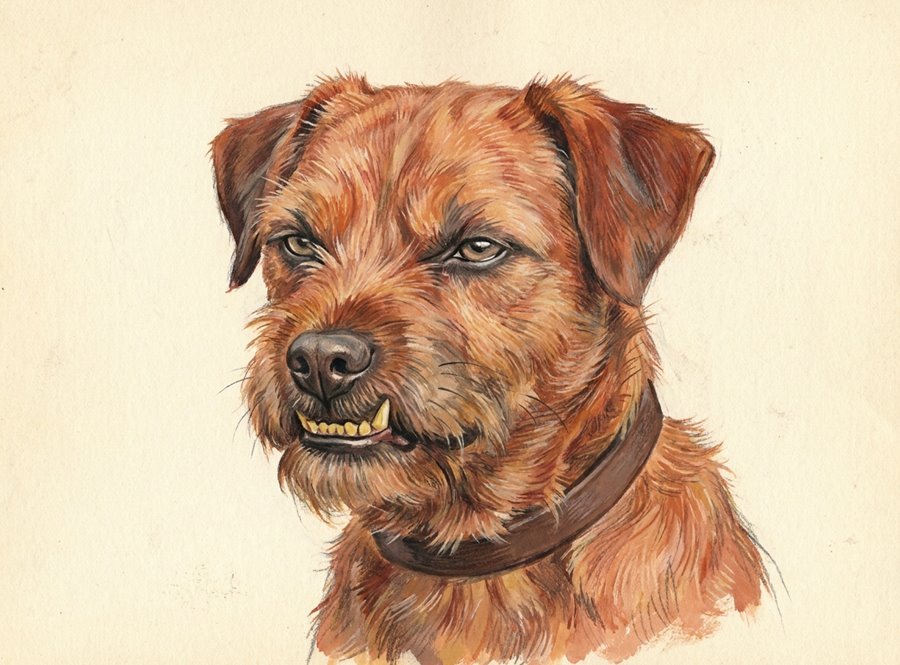
A low-pitched, sustained rumble, usually on the out-breath, often quieter than people expect and easy to miss under a television. The dog is typically still or slowing: head level or lowered, eyes locked on one point, breathing shallow. Lips may push forward with the front teeth showing, or stay closed over a rumbling jaw. The tail may be high and rigid or clamped down. Movement often stops a moment before the sound starts.
What it often means
This is a distance-increasing request aimed at whatever is approaching or continuing. In the clinical escalation ladder it sits above freezing and staring and below snapping and biting, which makes it a warning rather than an attack in progress.
Quieter signals came first and were missed: a head turn, a lip lick, a yawn, a slow blink. Rugaas's calming-signal account of that sequence is practitioner-derived and not peer-reviewed, and it lines up with the escalation ladder used in veterinary behaviour practice.
The subject of the growl varies: food, a chew, a resting place, being reached for, being restrained, an unfamiliar person, another dog. The behaviour looks the same and the plan is different, so record what was happening rather than only that it happened.
Pain or physical discomfort is doing the work. Growling that appears only during handling, grooming, lifting, or getting up should be treated as a medical question first, because review evidence identifies pain as a frequent and under-recognised contributor to behaviour change.
The threshold and the length of the warning differ between dogs. Some give several seconds of clear notice and others a fraction of a second. Dogs handled with confrontational or aversive methods more often show defensive responses in survey and review evidence.
A low growl is rarely the first thing a dog tries. When one appears to come out of nowhere, the earlier signals were usually too small or too fast to catch, or previous punishment has shortened them.
What it does not mean
- It does not mean the dog is dominant, testing you, or claiming rank. That framework came from misread captive wolf studies, corrected by the researcher who ran them, and it does not describe households of dogs and people.
- It does not mean your dog is aggressive as a fixed trait, or that a bite is now inevitable. In clinical accounts the growl is the step that exists so a bite does not have to happen.
- The face your dog makes afterwards is not remorse. In the study behind the so-called guilty look, that expression tracked whether the owner was scolding rather than what the dog had done. It examined a different situation, but it is good reason to distrust apology read into a dog's face.
- It is not solved by standing your ground, holding the dog down, or telling him off. Confrontational and aversive responses are linked to more defensive aggression and poorer welfare, not to fewer growls.
What changes the reading
| When | Effect on the reading |
|---|---|
| The growl happens when you approach food, a chew, or a stolen item | Read it as guarding. Do not reach in, do not attempt a swap while the dog is already tense, and rebuild the routine later at a distance that produces no growl. |
| The growl happens when the dog is touched, lifted, or asked to move off furniture | Move pain up the list. Arrange a veterinary examination, and in the meantime invite him with food, or use a light house line left on under supervision, rather than reaching with hands. |
| The dog is on a lead, in a corner, on a lap, or behind furniture | Escape is blocked, so escalation can be much faster. Open the exit before you do anything else. |
| The growl is aimed at a child, or a child is nearby | Full stop. Separate calmly, use a physical barrier for every future contact, and get qualified force-free help before the situation can repeat. |
| Growling has been punished in the past | Assume the warning has been shortened. Work from the earliest signs instead: stillness, a half-moon of white at the eye, a tight closed mouth, a lowered head. |
| The growl happens at the vet or during grooming | Treat it as a handling and consent problem rather than disobedience. Low-stress handling, frequent breaks, and food-based cooperation reduce the need for the growl. |
Read the whole dog
Seen together, these strengthen it
- Body freeze or a clear drop in movement just before the sound
- A hard stare held on the person, dog, or item
- A half-moon of white at the corner of the eye while the head turns away
- Front lips pushed forward, teeth visible, muzzle wrinkling
- Body over or curved around a resource
- Tail high and rigid, or tucked hard with a lowered body
- Weight loaded forward, or a slow backwards lean with the head still pointed at you
- Earlier attempts to leave that were blocked or ignored
Seen together, these point elsewhere
- Loose, wiggly body with a swinging tail and no stillness
- A play bow, or bouncy exaggerated movement between growls
- An open mouth with relaxed lip corners and a lolling tongue
- The growl pausing and restarting in time with a tug game
- The dog voluntarily returning and re-engaging after you stop
- Growling that begins only when a toy is picked up and ends when it is dropped
How confident we are
The escalation ladder is documented clinical consensus rather than an experiment, and real dogs skip rungs or run them out of order. The sound cannot tell you whether fear, frustration, or pain sits behind it, and the pain link rests on review evidence rather than controlled trials. Individual learning history predicts warning length better than breed does.
Safety
Common questions
My dog growled at me for the first time. Is he turning aggressive?
Almost certainly not in the way you fear. A growl usually appears when a dog has run out of quieter ways to ask for space. Treat it as information rather than defiance, look for pain if it is linked to touch or movement, and change the situation instead of the sound. Get qualified force-free help early.
What should I do in the exact moment my dog growls?
Stop moving, soften your gaze and look slightly away, then take a slow step back so the distance being asked for actually arrives. Do not grab the collar, lean over, or reach past him. Move yourself out of the space rather than moving the dog, and write down what was happening so it can be avoided next time.
Why is punishing a growl so risky?
Because the feeling that produced the growl stays, and only the sound goes. A dog who learns that warning brings trouble may go quiet and then react with almost no notice, which is more dangerous for everyone in the room. Survey and review evidence links confrontational and aversive handling to more defensive aggression.
Can pain make a dog growl?
Yes, and it is easy to miss. Sore joints, ears, teeth, skin, and spines all make handling unpleasant, and a growl during lifting, grooming, or getting up is a common presentation. Review work identifies pain as a frequent and under-recognised contributor to behaviour problems, so a veterinary examination comes before any training plan.
Should I still let my dog on the sofa if he growls there?
Not while the growling is happening, and never by removing him by force. Manage it instead: make the sofa unavailable for now, give him a comfortable bed with a clear approach from every side, and teach a move-off cue that pays well, practised at a distance that produces no growl.
Sources for this entry
Every claim above is graded. Open the source register for the full citation, what it actually establishes, and its limits.
Practical guides
Longer, practical write-ups on the everyday side of this.
See it in context
A single signal is never enough on its own. Put this one together with the rest of what you are seeing, and the interpreter will show you the reasoning and how confident it is.
Method last updated . Built from and checked against the sources listed above. Think we got this wrong?